WRITING SAMPLES
Rhetoric as Civic Education
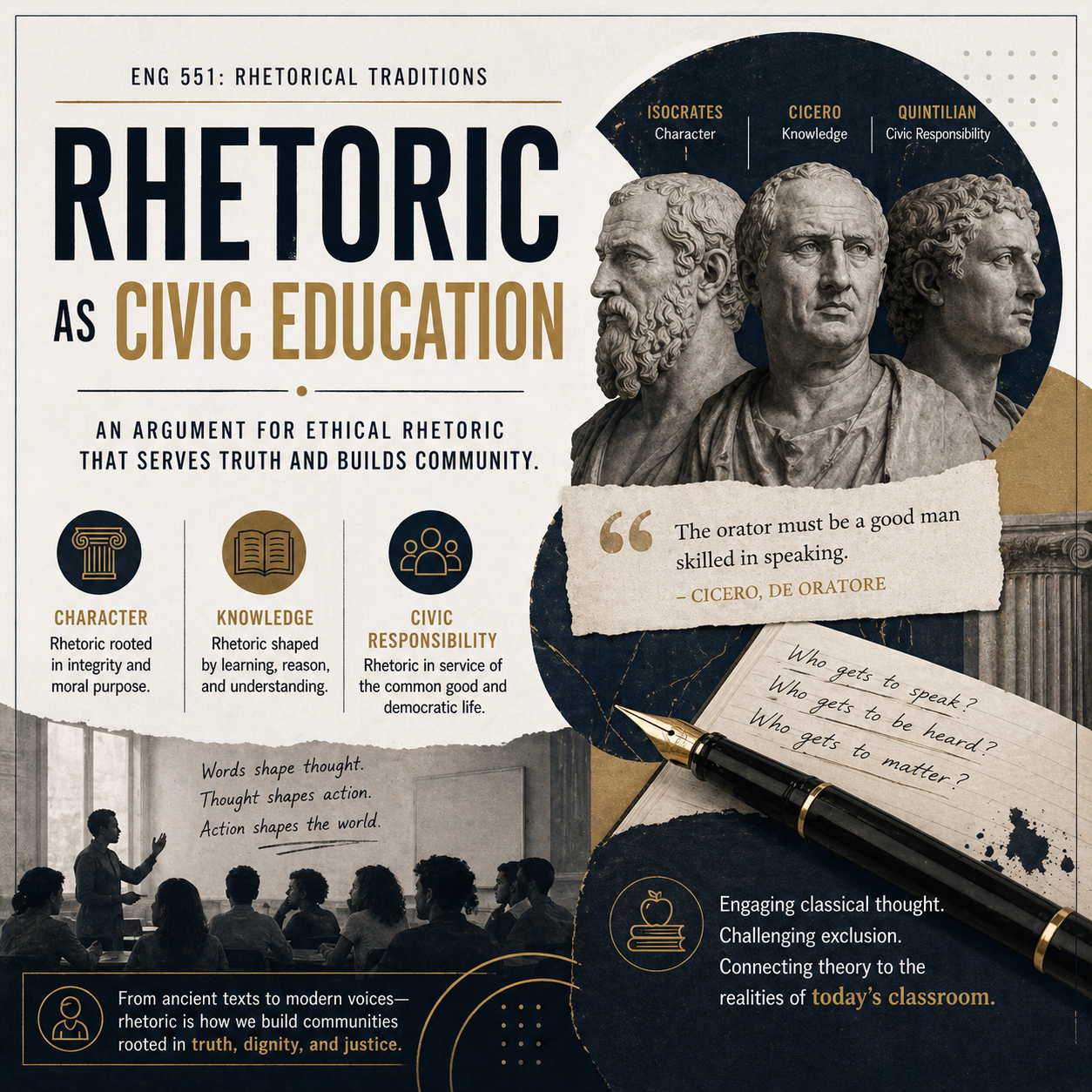
This essay was the final reflection for ENG 551: Rhetorical Traditions, a graduate course examining the history and theory of rhetoric from ancient Greece through contemporary practice. The assignment asked me to advocate for a model of rhetoric supported by primary source readings and to reflect on how my thinking evolved across the semester. I argued for the classical ethical model as developed by Isocrates, Cicero, and Quintilian, which treats rhetoric not as a neutral technique but as a practice tied to character, knowledge, and civic responsibility. Writing this piece pushed me to think seriously about who the classical tradition includes and excludes, particularly as a teacher working with students who have historically been kept at the margins of the kinds of public discourse these thinkers valued. This essay demonstrates my ability to engage primary theoretical texts through close reading, synthesize competing scholarly frameworks into an original argument, and connect graduate level inquiry directly to the realities of my classroom. Rhetoric is not just persuasion that works. It is persuasion that deserves to work because it serves truth and builds community. That conviction now shapes how I approach writing instruction, discussion, and advocacy every day. Click here to read.
Reading Banned: LGBTQ+ Voices and Censorship
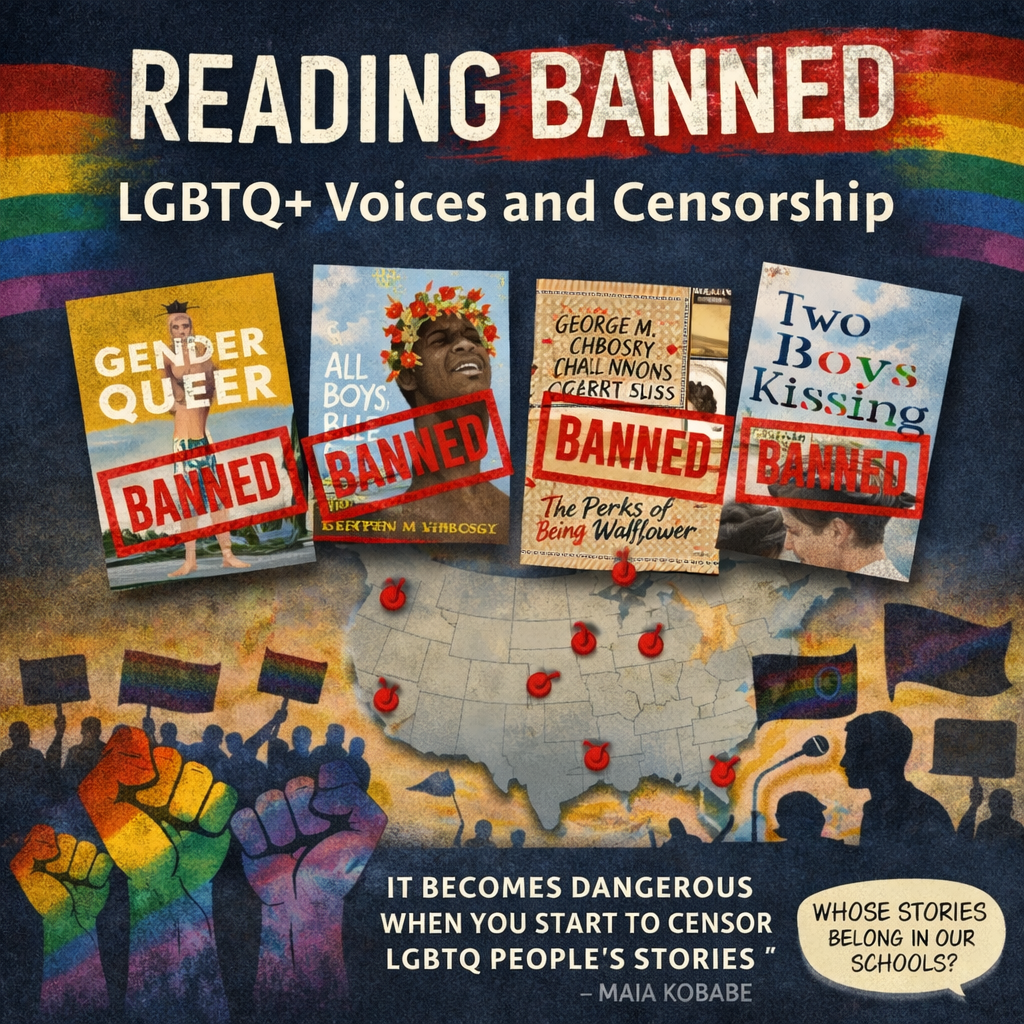
This Pecha Kucha style presentation was the final project for ENG 540: Teaching Young Adult Literature, a graduate course examining how YA texts function as tools for identity development, critical literacy, and social action. My unit, Reading Banned: LGBTQ+ Voices and Censorship, was designed for grades eleven and twelve and centered on four of the most challenged books in the country, including Maia Kobabe's Gender Queer, George M. Johnson's All Boys Aren't Blue, Stephen Chbosky's The Perks of Being a Wallflower, and David Levithan's Two Boys Kissing. The unit was grounded in four theoretical frameworks, Bishop's mirrors, windows, and doors model, Lewison's critical literacy framework, Alsup's conception of YA literature as social action, and Rosenblatt's reader-response theory. Students moved from reading to analysis to civic action through a censorship mapping exercise, a mock school board hearing, a formal book defense essay, and a multimodal advocacy project. This project demonstrates my skills in theory-driven curriculum design, thematic unit planning, and the integration of critical literacy pedagogy into secondary ELA instruction. It reflects my conviction that literature education is not politically neutral and that teaching students to read critically, argue evidence-based positions, and engage democratic processes is among the most important work an English teacher can do. Click here to read.
Power in Reserve: How Spy and Detective Fiction Actually Holds Power
This essay was the final project for ENG 504: Spies and Detection, a graduate course examining the conventions and critical frameworks of spy and detective fiction. The assignment asked students to identify three recurring structural elements across the genre and propose an original thirteenth element not overtly named in the course material. My essay argues for what I call Power in Reserve, the ending logic in which victory is not the public release of truth but the acquisition of information that could destroy someone, paired with an intentional decision not to deploy it openly. Working across five texts including Poe's "The Purloined Letter," Doyle's "A Scandal in Bohemia," Cheng Xiaoqing's "The Other Photograph," Ambler's A Coffin for Dimitrios, and Greene's Our Man in Havana, I track how three constant structural elements function differently as the genre shifts from detective fiction to espionage fiction. The essay received a score of 195 out of 200, with the professor describing it as a complex and ambitious argument executed with manifest success. This piece demonstrates my ability to construct an original scholarly argument, engage closely with primary literary texts across multiple traditions, and synthesize critical secondary sources into a coherent and persuasive analysis. Click here to read.
Teaching Philosophy
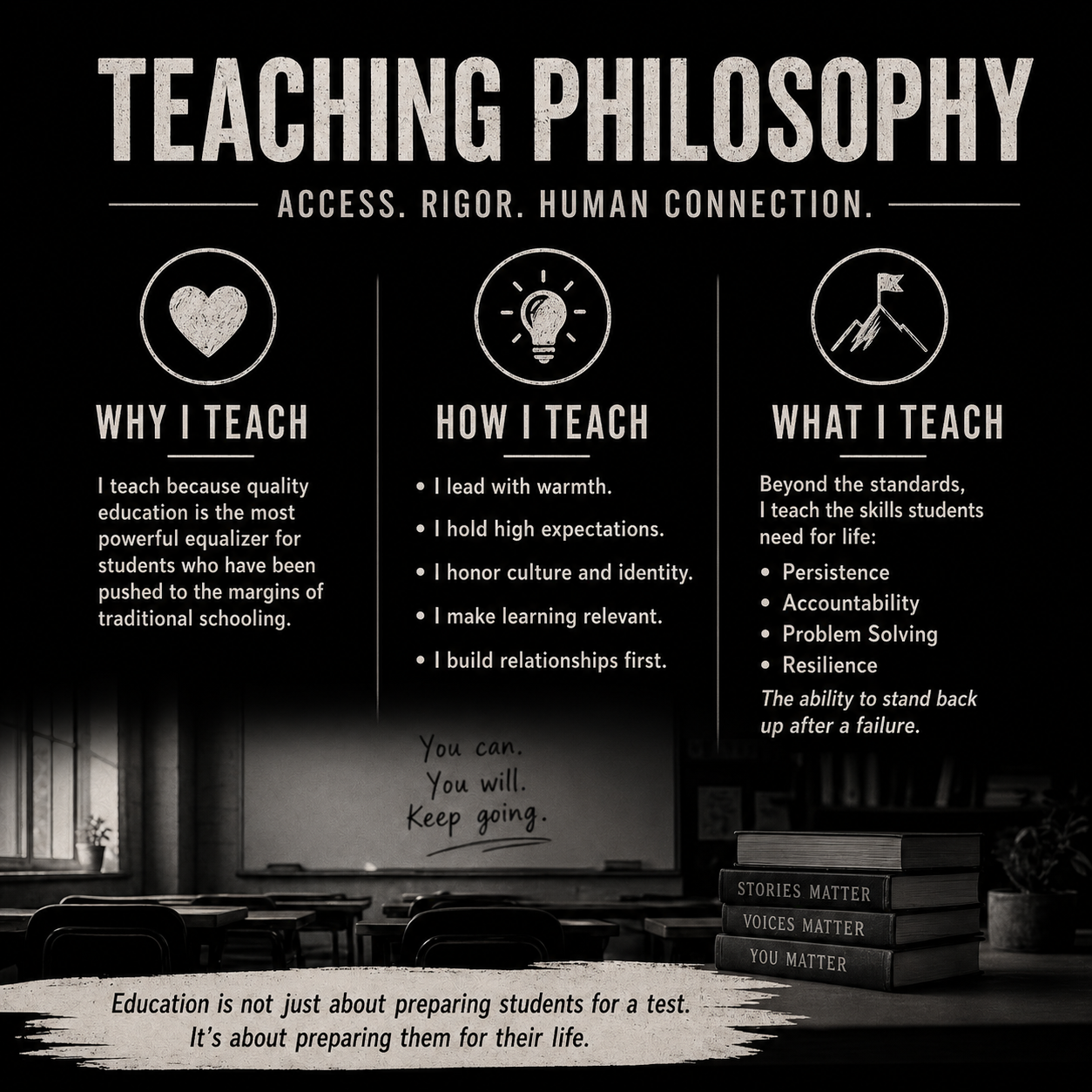
This teaching philosophy articulates the values and convictions that have shaped my practice across eight years of secondary ELA instruction at an alternative school. Organized around three questions, why I teach, how I teach, and what I actually teach beyond the standards, it reflects a career built on the belief that quality education is the most powerful equalizer available to students who have been pushed to the margins of traditional schooling. The how reflects my commitment to warmth, high expectations, cultural sensitivity, and real world relevance. The what goes beyond content to include persistence, accountability, problem solving, and the capacity to stand back up after a failure, skills that matter most for the students I serve. This document demonstrates my ability to articulate a coherent pedagogical philosophy grounded in both lived classroom experience and the theoretical frameworks I developed through graduate study, including culturally sustaining pedagogy, reader-response theory, and critical literacy. It shows that my values as an educator are not abstract. They are visible in every lesson I design and every decision I make about what my students need and deserve. Click here to read.
Poe Unit
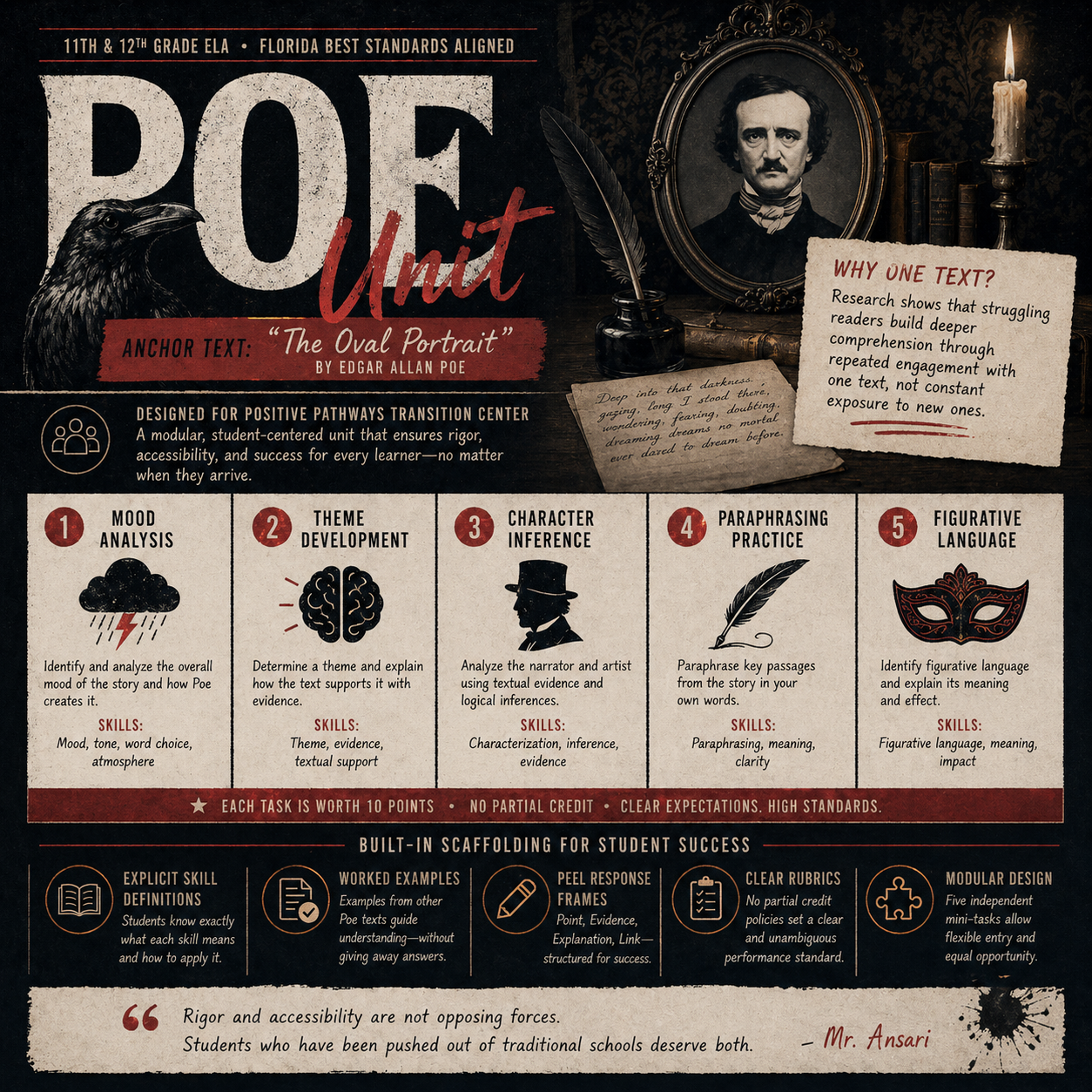
This assignment was designed for eleventh and twelfth grade students at Positive Pathways Transition Center and aligned to tenth grade Florida BEST ELA Standards in order to meet graduation readiness targets including the FAST exam. Using Edgar Allan Poe's "The Oval Portrait" as the anchor text, the assignment is structured as five independent mini-tasks worth ten points each, a modular format that allows students who arrive mid-unit to complete any task without depending on previous ones. Each task targets a distinct reading skill including mood analysis, theme development, character inference, paraphrasing, and figurative language interpretation. Rather than introducing a new text for each skill, the assignment uses a single short story across all five tasks, a deliberate instructional choice rooted in research showing that reluctant and struggling readers build deeper comprehension through repeated engagement with one text than through constant exposure to new material. Every task is scaffolded with explicit skill definitions, worked examples drawn from different Poe texts so as not to reveal the answers, PEEL structured response frames, and no partial credit rubrics that set a clear and unambiguous performance standard. The assignment reflects my conviction that rigor and accessibility are not opposing forces and that students who have been pushed out of traditional schools deserve instructional materials that take both their challenges and their intelligence seriously. Click here to view.
Integrating Pedagogy, Text Selection, and Student Voice: A Literature Review of Effective Literacy Instruction for At-Risk Secondary Students in Alternative Schools
This literature review was completed for ENG 501: Introduction to Research Studies, the foundational research course in the ASU MA in English Studies program. The assignment required synthesizing a minimum of eight peer-reviewed academic sources around a self-selected research problem. I chose to examine literacy instruction for students in alternative educational settings, a population that remains significantly underrepresented in mainstream English studies research despite comprising substantial numbers in secondary education, particularly in urban districts. Drawing on fourteen peer-reviewed sources published primarily between 2020 and 2025, the review argues that effective literacy instruction for alternative school students requires integrated frameworks combining culturally sustaining pedagogy, accessible text selection, and authentic attention to student voice rather than addressing these elements in isolation. This piece demonstrates my skills in academic research, source synthesis, and critical scholarly writing, and marks the beginning of a research agenda I intend to pursue as I move into instructional leadership and college level teacher preparation. There is almost no published research on the specific population I teach every day, and I believe that gap is itself a problem worth naming and working to close. Click here to read.
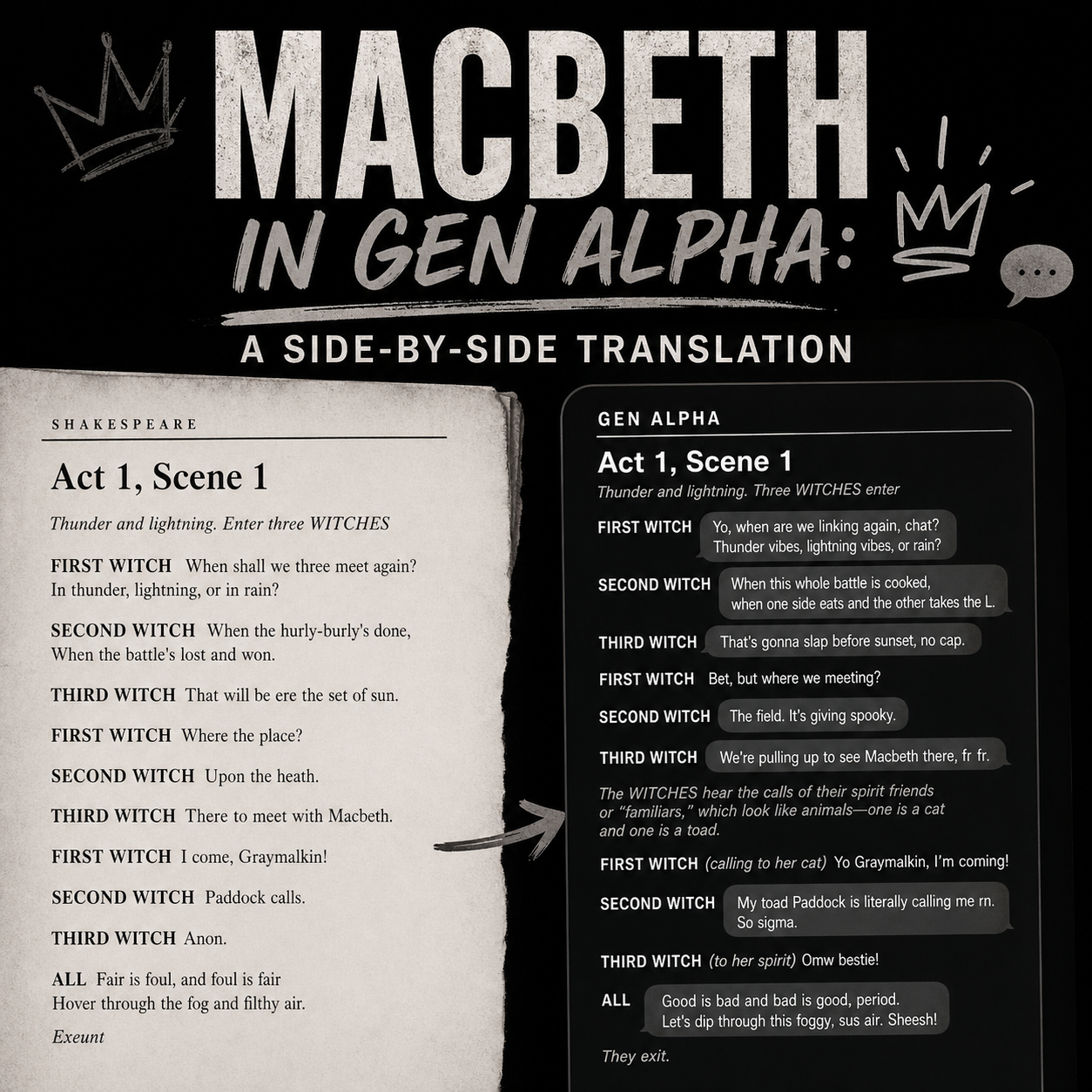
Macbeth in Gen Alpha: A Side-by-Side Translation
This project grew directly out of a challenge I face every day in my classroom. My students arrive with reading levels and life experiences that put Early Modern English almost completely out of reach, and traditional Shakespeare instruction tends to widen that gap rather than close it. To address that I created a full side-by-side translation of Macbeth, placing Shakespeare's original text alongside a contemporary Gen Alpha version that renders every scene in the slang, cadence, and cultural references my students actually use. The goal was not to replace Shakespeare but to build a bridge into him, giving students a way to track meaning, tone, and dramatic structure in language that felt native to them before crossing over to the original. This project demonstrates my skills in curriculum differentiation, scaffolding for diverse learners, and the practical application of culturally sustaining pedagogy in a secondary ELA classroom. It reflects a conviction central to my teaching: that access to complex literature is a design problem, not a student problem, and that rigorous engagement with canonical texts and genuine accessibility for diverse learners are not competing goals but the same goal approached from different angles. Click here to read.
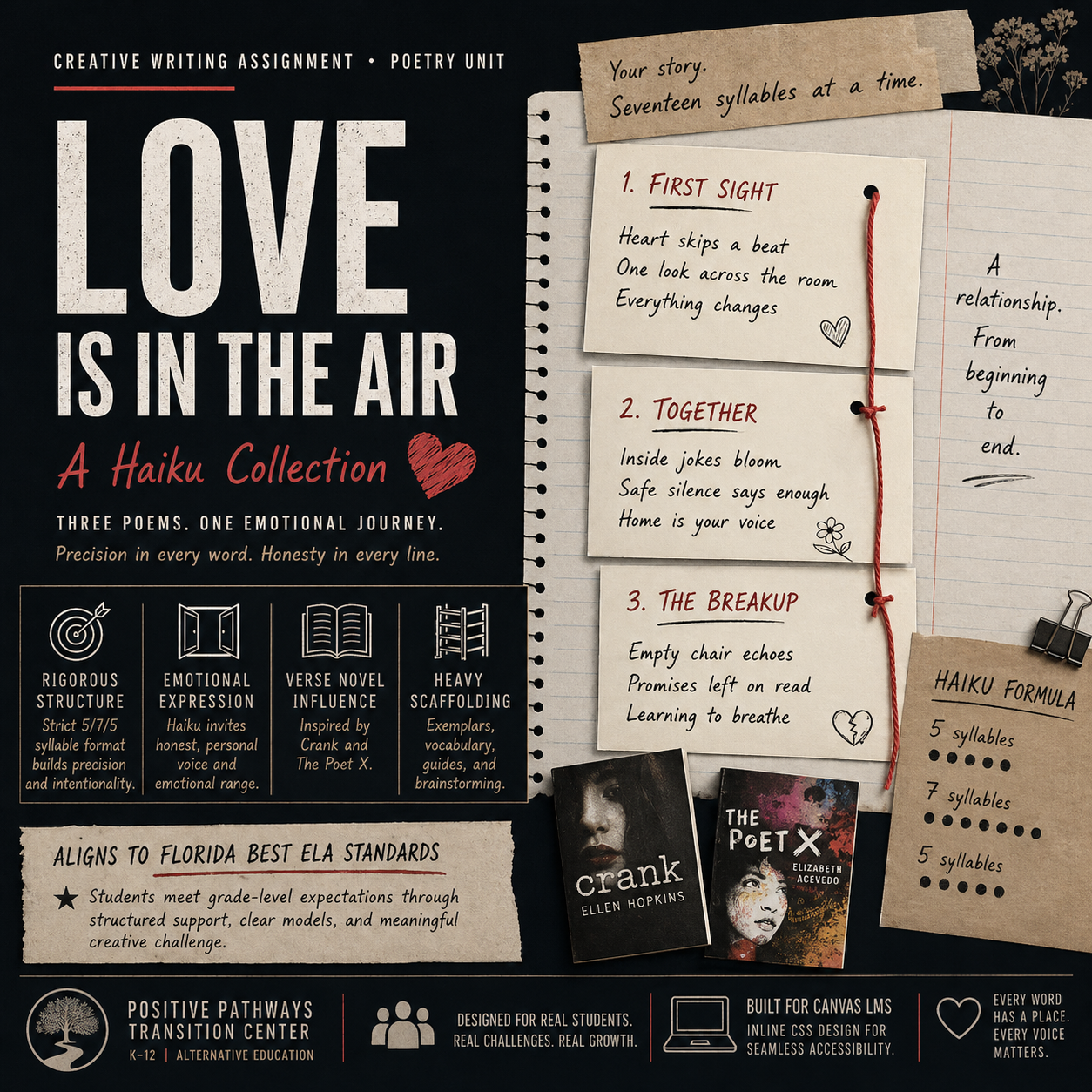
Love Is In The Air
This assignment was designed for students at Positive Pathways Transition Center, an alternative public school in Florida serving grades K through 12 where students arrive and depart on a rolling enrollment schedule throughout the year. Because many of these students have experienced significant disruptions to their education, the assignment had to be simultaneously rigorous and deeply accessible, giving students a meaningful creative challenge without creating barriers that would discourage participation. The haiku format was chosen deliberately for its strict structural demands, which teach precision and intentionality in word choice, and for its emotional range, which invites honest self-expression from students who often struggle to engage with traditional academic writing. The three prompts trace a complete emotional arc through the experience of a relationship, a framework inspired by verse novels like Crank by Ellen Hopkins and The Poet X by Elizabeth Acevedo that I encountered during my Young Adult Literature coursework in my MA program. The assignment reflects my approach to curriculum design at this stage of my development as an educator: building materials that maintain grade-level academic expectations and align to Florida BEST ELA Standards while providing heavy scaffolding through exemplar texts, explicit vocabulary instruction, and guided brainstorming questions. The visual design was built for delivery through Canvas LMS using fully inline CSS styling, a technical constraint specific to the platform that required careful attention to how formatting choices translate across different digital environments. Click here to view.